
 I told you I’d be giving you more reasons to justify buying that big set of cookie cutters!
Use the cookie cutters as a template to trace a shape onto the back side of sand paper. Experiment with a variety of grits as the different grits give different textures in the rubbings. Cut out the desired shape. (While I wouldn’t necessarily use your favorite pair, I have heard that cutting sandpaper may actually sharpen your scissors!) Securely glue the shape onto an index card. Place the index cards out with your art trays, paper, and crayons. The children can choose the shapes they want, place the paper on top, and rub with the crayons to transfer the picture onto their papers. The children can place several templates under one paper to create their desired scene.
 So you’ve found a way to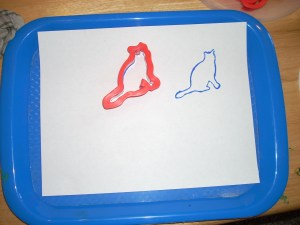
 Superhero play is a theme that appears to enter into the imaginative play of every child at one time or another. In fact, researchers French and Pena (1991) have found that the theme of superhero play has greatly increased since the advent of television, specifically for children in the early childhood years. Other researchers hypothesize that boys in particular have a natural inclination toward “weapon play” that may be genetically tied to the Y chromosome. Whether hero play is brought on by media influences or genetic inclinations, there are many ways children can benefit from this type of play with the proper guidance.
 My own boys love playing in colored rice! They’re not the only ones though. I had a tray of colored rice sitting on my counter one day when my friend dropped by to visit. During our conversation she began running her fingers through the grains, scooping and dumping as we talked. After a while she said, “There’s just something soothing about this stuff!” It’s true, the feel of rice sliding through your fingers, the soft rustle of it as it falls into a pile, there’s something that just captivates young and
 The advent of writing is a momentous time in any child’s life. It is important to realize that the process preparing a child to write begins very early in life; long before she puts pencil to paper. I view the development of writing as having three major components: 1. Fine motor control, 2. Understanding that print carries meaning, and 3. An increased awareness of the alphabetic principle, leading to more conventional spelling.


